Question - Why do most of my plants die in around a months time? Why do I have to keep
buying some more?!! Is it plastic fantastic for the rest of my life?
Hey, calm down, you can keep some of your plants alive even though your aquarium is low-tech.
Yeah, certainly some can fail, and make no mistake, plenty of mine have. I'm not saying that unless you have
a degree in botany you will be successful, but it's a whole lot helpful if you have some
knowledge about aquatic plants. Plants need these basic few things:
A good substrate (Substrate?You what?): To start off with, you've gone and
bought some nice, coarse, gravel - no wonder your plants have problems rooting. A good
substrate is really needed, and 2-3 mm, low-calcium beach gravel available from your aquatic shop
will be a good start.
Using this sort of substrate, allows the roots to penetrate easily, and anchors the plant -
a big no-no to coarse gravel, as the plants will just give up and go home. Well, they'll die
to be precise.
Other types of substrate are:
Laterite: Iron-rich clays, in a reddish colour, you can buy some in your local pet
shop. Why bother? You don't have to, but this will add some iron into the substrate.
You can get it in a pellet form, where you just mix it with your normal gravel, and then add
a 100% gravel top layer. The roots can go directly into the substrate. By doing this, you
don't have to use so much fertiliser in the water column, minimise the risk of algae breakouts.
And doesn't everyone just love an algae breakout?
Sand: Using sand as a 100% substrate can be detrimental to the plants, as it can
compact quite tightly, and therefore roots can rot away in dead patches.
Nutrients: A good mixture is needed if the plants are to thrive. Iron is one of the
important elements, for the green pigment of plants (chlorophyll). Other elements include:
Manganese, Zinc, Magnesium, Copper, Boron, Potassium, Sulfur, Phosphorous, Calcium,
Nitrogen. No mean list there - You may thinking, "what am I meant to do? Go and buy a
bloody laboratory to check the amount of nutrients in my water!!" No, its not realistic is it.
Many of those nutrients will be free in your tap water, and you can buy a liquid fertiliser,
or 2, to make sure you are adding enough. Plants will also use the Nitrates in your aquarium,
which is no bad thing at all. You have got to try to balance the fertiliser with the plants,
and it's a bit of a tricky old situation. If you go and drown your aquarium with fertiliser, algae
can come a' calling. For instance, Iron content doesn't need to be anymore than 1ppm.
Now what about Photosynthesis - light/CO2? Do I need it in a aquarium? Of course
you do!! Every plant needs this little bit of magic. And how much CO2 will be needed then?
And light? Now its's getting a bit trickier, you start delving into the more advanced side of
the hobby. The fish in your aquarium will give off CO2 (respiration), but it won't be that much.
If you are really going for a heavily planted tank with some tough plants, You could add some CO2, and place some extra bulbs in your tank. And how much CO2 would be needed
for the average plant? 15 - 30 ppm won't go too far off. A bit different from iron 1ppm hey!!
And you could use a CO2 injection system. No,no, don't all run away, if you know what you
are doing, you wont kill all of your fish in one fell swoop. I'm not going to try explaining
everything on this page, as this can be quite complex. One thing is certain - don't go out and buy 100 lamps if you have no
CO2 system, as Photosynthesis will only occur if there is a balance between light/CO2.
Water conditions: Is every plant a hardy one? Unfortunately, no. Some need
quite specific conditions - say, the "Isoetes Setacea", needs these properties for it to
thrive: KH: 2-5, pH: 5.5-6, and needs a lot of bright light. Now if I had a tank with the specs, let us say - about 8KH;
pH 7.5, and one bulb, theres not much chance of me keeping this plant alive for a very
long time, no matter how much fertiliser, or good substrate I have.
Although plants will
use Nitrates as a source of food, and your tank has levels of 20-30ppm or over, some plants can be
affected badly. Only 20-30ppm? That's not right surely? I hear what you say, but if you look
around for pics for heavily planted tanks, often there will be a smaller population of fish compared
to the normal stocking level.
Here's some info on some tough, low light plants, that anyone should be
able to keep alive:
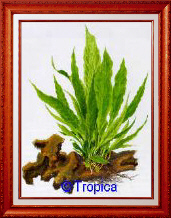
Java Fern (Microsorium pteropus):
PH: 5.5 - 7.5
Temp: 20 - 25C
KH: 2 - 12
Java Fern is very popular, you'll probably have bought some of this already.
In the natural enviroment, it creeps over logs and rockwork, attaching itself by
roots. Its often used to decorate bogword, where the Rhizomes can be secured
by wire or a nylon thread, until they become firmly attached. It can grow in subdued
light
Specs look good eh? And it's a very attractive plant as well. It grows rapidly in a range of
water conditions, perfect to start off your aquarium with. It would like quite a bit of bright
light, but you can get by with 1.5 Watts per Gallon. When it actually hits the surface of the
water, it will start to run horizontally, and runners will pop out. You could cut the tops and
re-plant it, it helps to rejuvinate it.
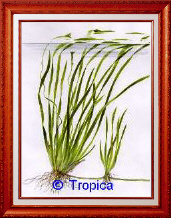
This is a linear, grasslike plant, perfect for a backgroud aquarium. They can grow quite rapidly,
and could reach up to 60cm. Its another plant that would do well in bright light, but will tolerant
light shade. It can be quite indifferent to water quality in your aquarium - buy it!!
Need more info about CO2? What sort of light? Propagation? Effect of agitation? Try the
"Aquatic Plants" forum